
The Science of Neurofeedback
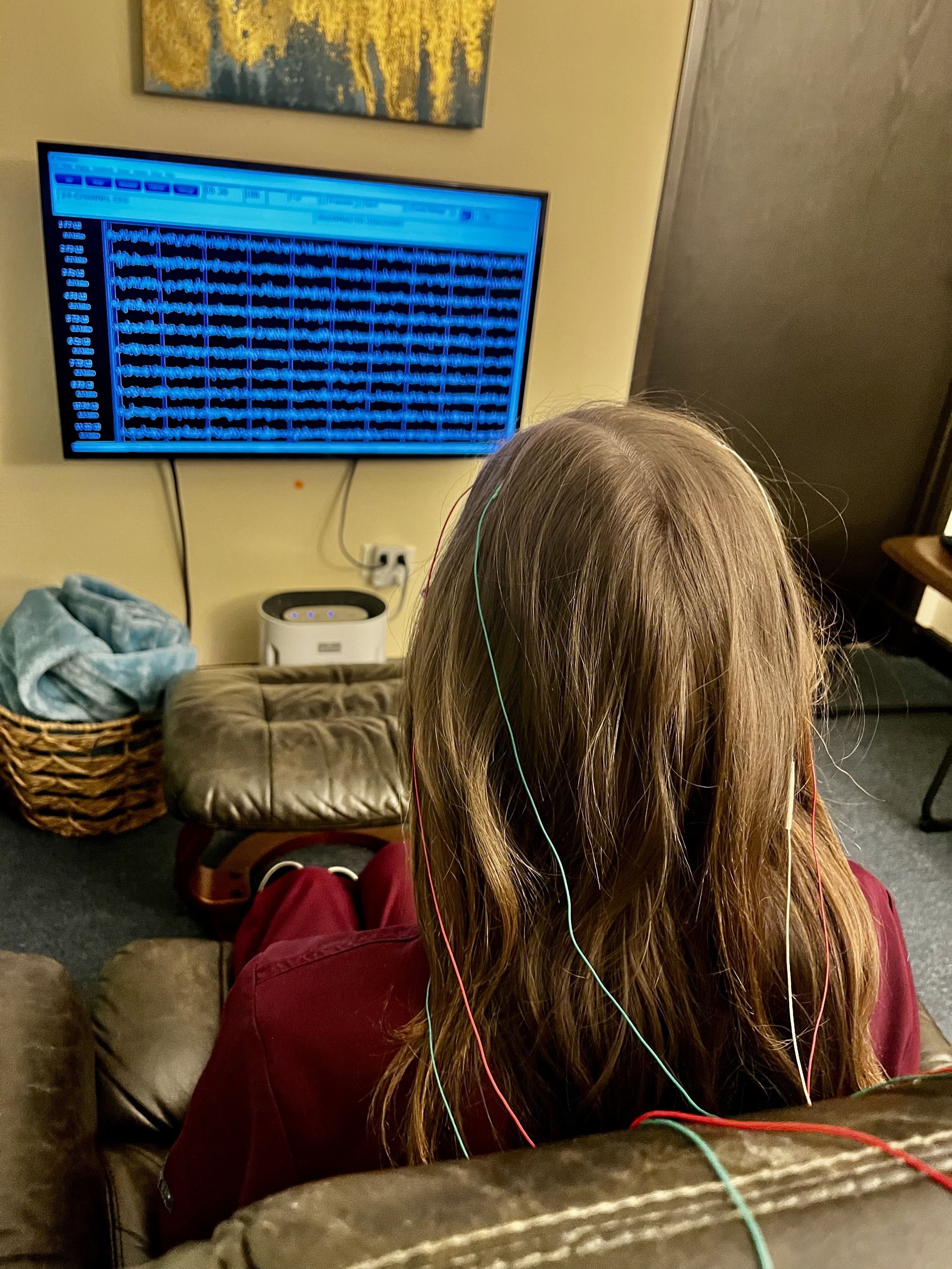
Your brain learns through feedback.
During training, sensors placed on the scalp measure electrical activity in the brain using EEG technology. Those signals are sent into specialized software that monitors your brainwave activity moment-to-moment.
As your brain reaches target threshold goals:
The image brightens
Audio rewards play
As your brain moves away from target thresholds goals:
The image darkens
Audio rewards decrease
Your brain automatically notices these changes and begins adapting toward more efficient functioning. No conscious effort required.

It’s like learning to ride a bike
Neurofeedback works through the brain’s natural ability to learn and adapt, called neuroplasticity.
You do not consciously “control” the training.
Your brain simply learns:
“This pattern works better.”
Over repeated sessions, those healthier patterns become easier and more automatic.

Neurofeedback, trauma, and nervous system regulation
Trauma often changes the way the brain regulates:
Safety
Attention
Emotional processing
Stress recovery
Many trauma-related symptoms are actually nervous system adaptations.
At AllNeuro Pathways, clinicians use evidence-based neurofeedback approaches designed to support trauma recovery and nervous system regulation, including:
Infraslow Fluctuation Training (ISF)
SMR Training
Alpha-Theta Training
Amplitude/Power Training
Referential Training
Multivariate Coherence (MVC)
These approaches help support:
Emotional stability
Reduced hypervigilance
Better sleep
Increased focus
Greater resilience to stress
-
Many people come to neurofeedback after realizing:
Talk therapy alone wasn’t enough
Stress management tools only worked temporarily
Their brain and nervous system still felt stuck in survival mode
Neurofeedback offers a different approach:
Training the system directly.Clients often report:
Feeling calmer
Thinking more clearly
Sleeping better
Recovering from stress faster
Feeling more present and connected
-
Yes.
Neurofeedback is:
Non-invasive
Drug-free
Based on learned brain activity only
Nothing is being “put into” your brain.
The process simply helps your brain learn more effective patterns through feedback and repetition.
-
No! Brainwaves are electricity, and the electrodes used are only monitoring your brainwave patterns to offer rewards when your brain is balanced.
-
Different brainwaves are associated with different mental and emotional states.
Delta (1–4 Hz)
Deep sleep, restoration, and complex processing
Theta (4–7 Hz)
Creativity, meditation, insight, and internal processing
Alpha (8–12 Hz)
Relaxation, processing speed, and cognitive efficiency
SMR / Low Beta (12–15 Hz)
Calm attention, regulation, and motor control
Beta (15–20 Hz)
Alertness, focus, and active thinking
High Beta (20–33 Hz)
Hyperfocus, stress activation, and high mental intensity
Neurofeedback helps improve flexibility between these states so the brain can respond more appropriately to different environments and demands.
-
Get an expert response by emailing our Clinical Care Coordinator, or book a free virtual consult to learn more!